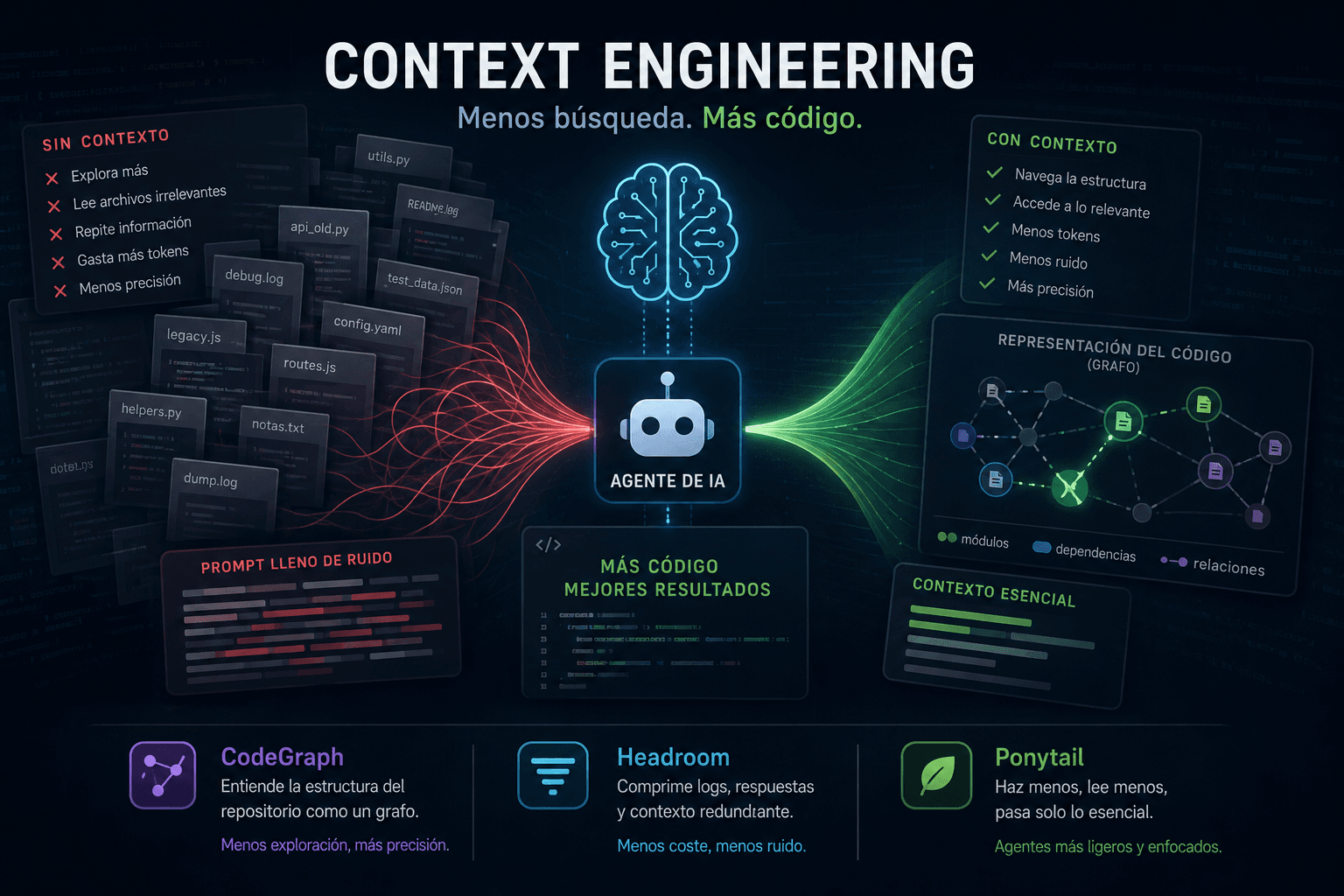
If you're using AI agents for programming and still aren't paying attention to the context you send them, you're probably wasting more time and money than necessary.
Lately, I've been exploring and using these projects:
- CodeGraph (https://github.com/colbymchenry/codegraph)
- Headroom (https://github.com/chopratejas/headroom)
- Ponytail (https://github.com/DietrichGebert/ponytail)
And they all share an idea I find fundamental:
Context quality matters more than context quantity.
🧠 The Mindset Shift in AI Agents
For years we've talked about Prompt Engineering, but this is evolving.
Now the problem isn't just what you tell the model, but:
- What information you give it
- How much information you give it
- And, most importantly, what information you decide NOT to give it
This is where the concept of Context Engineering comes in.
🔧 Three Approaches, Same Idea
These three projects tackle the problem from different angles:
🔹 CodeGraph
CodeGraph lets agents understand a repository structure without constantly reading the entire codebase.
Instead of "scanning files," the agent navigates a structured representation of the code.
👉 Result: less exploration, more precision.
🔹 Headroom
Headroom drastically reduces token usage by compressing:
- logs
- intermediate responses
- redundant context
👉 Result: lower costs and less noise for the model.
🔹 Ponytail
Ponytail is more philosophical than technical:
- do less
- read less
- pass only the essentials to the model
👉 Result: lighter and more focused agents.
💡 The Common Pattern
What's interesting is that none of these projects tries to "make the model smarter."
They all do the opposite:
Remove friction between the model and relevant information.
📉 Clear Benefits
When you optimize context correctly:
- ✅ Lower token consumption
- ✅ Lower operational costs
- ✅ More relevant responses
- ✅ Less noise in the prompt
- ✅ Faster agents
- ✅ Better performance on large repos
🧪 A Real Example
Imagine a repository with thousands of files.
Without context tools:
- The agent explores multiple paths
- Reads irrelevant files
- Repeats exploration multiple times
- Consumes many tokens without making fast progress
With tools like CodeGraph:
- Identifies relevant dependencies
- Reduces search space
- Accesses the useful part of the code directly
The change isn't incremental.
It's structural.
🧩 The Real Bottleneck
After trying these approaches, the conclusion is pretty clear:
The problem with AI agents is rarely code generation.
The problem is:
Finding the right information within complex systems.
The larger the system, the more critical context becomes.
🎯 Conclusion
The evolution won't go only toward bigger or smarter models.
It will go toward systems that:
- understand context better
- reduce unnecessary information
- optimize what gets sent to the model
That's why we'll be talking more and more about Context Engineering, not just Prompt Engineering.
And probably, that's where the true competitive advantage lies in modern AI agents.