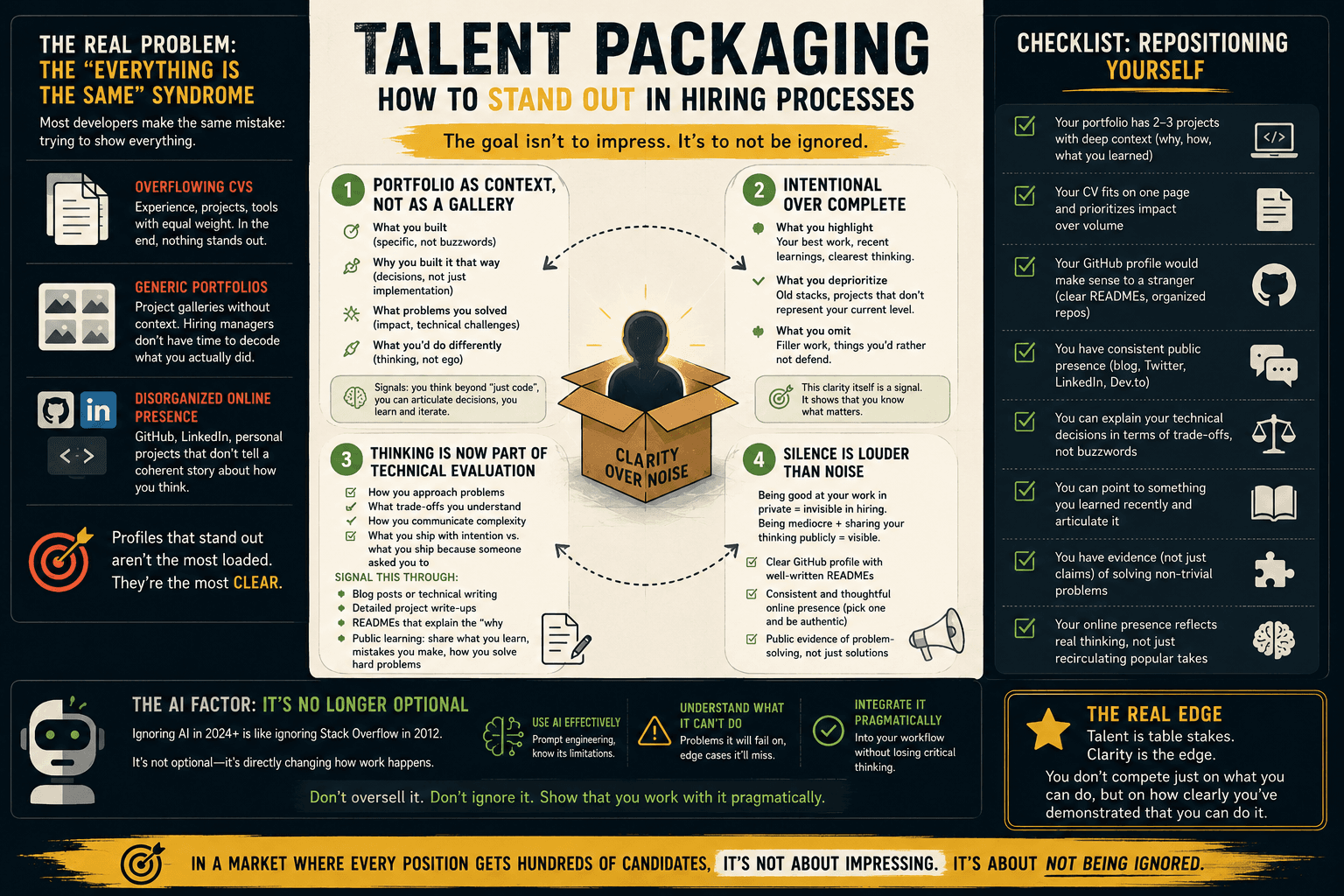
I've been reviewing candidate profiles in hiring processes, and there's something that repeats constantly: it's not a lack of talent. It's how that talent is packaged.
In an environment where a recruiter sees dozens (or hundreds) of candidates for the same position, small details end up having more impact than they seem to.
The goal isn't to impress. It's to not be ignored.
🎯 The Real Problem: The "Everything Is The Same" Syndrome
Most developers make the same mistake: trying to show everything.
- 📋 Overflowing CVs: experience, projects, tools with equal weight. In the end, nothing stands out.
- 🖼️ Generic portfolios: project galleries without context. Hiring managers don't have time to decode what you actually did.
- 🔀 Disorganized online presence: GitHub, LinkedIn, personal projects that don't tell a coherent story about how you think.
It's very clear when a profile is built "just to tick boxes" versus when there are actual decisions behind it: what you show, what you omit, how you structure it.
👉 Profiles that stand out aren't the most loaded. They're the most clear.
🏗️ The Four Pillars of Positioning
1. Portfolio as Context, Not as a Gallery
Your portfolio isn't a dumping ground for projects. It's the place where you build real context.
For each project, show:
- 🔹 What you built (specific, not buzzwords)
- 🔹 Why you built it that way (decisions, not just implementation)
- 🔹 What problems you solved (impact, technical challenges)
- 🔹 What you'd do differently (thinking, not ego)
This signals that:
- ✅ You think beyond "just code"
- ✅ You can articulate decisions
- ✅ You learn and iterate (you don't just ship and move on)
A portfolio that does this beats a CV. A CV compresses context too much to have real impact.
2. Intentional Over Complete
Stop trying to show everything. Instead, be deliberate about what you show and what you omit.
- What you highlight: Your best work, your most recent learnings, your clearest thinking.
- What you deprioritize: Old stacks, projects that don't represent your current level, work that doesn't show how you think.
- What you omit: Filler work, things you'd rather not defend.
This clarity itself is a signal. It shows that you know what matters.
3. Thinking Is Now Part of Technical Evaluation
Technical stack matters less than it used to. "I know how to use X technology" is table stakes, not differentiation.
What's really evaluated:
- 🔹 How you approach problems
- 🔹 What trade-offs you understand
- 🔹 How you communicate complexity
- 🔹 What you ship with intention vs. what you ship because someone asked you to
Signal this through:
- Blog posts or technical writing (even short ones)
- Detailed project write-ups
- READMEs on GitHub that explain the "why", not just the "how"
- Public learning: sharing what you're learning, mistakes you make, how you solve hard problems
4. Silence Is Louder Than Noise
Being good at your work in private = invisible in hiring.
Being mediocre + sharing your thinking publicly = visible.
This isn't about performative personal branding. It's about having a documented point of view.
- ✅ Clear GitHub profile with well-written READMEs
- ✅ Consistent and thoughtful online presence (LinkedIn, Twitter, Dev.to—pick one and be authentic)
- ✅ Public evidence of problem-solving, not just solutions
In a sea of silence, a clear voice stands out.
🤖 The AI Factor: It's No Longer Optional
Ignoring AI in 2024+ is like ignoring Stack Overflow in 2012. It's not optional—it's directly changing how work happens day-to-day.
Hiring managers notice:
- 👉 If you use AI effectively (prompt engineering, know its limitations)
- 👉 If you understand what it CAN'T do (problems it will fail on, edge cases it'll miss)
- 👉 If you've integrated it pragmatically into your workflow without losing critical thinking
Don't oversell it. Don't ignore it. Show that you work with it pragmatically.
✅ Checklist: Repositioning Yourself
Before your next hiring process:
- [ ] Your portfolio has 2-3 projects with deep context (why, how, what you learned)
- [ ] Your CV fits on one page and prioritizes impact over volume
- [ ] Your GitHub profile would make sense to a stranger (clear READMEs, organized repos)
- [ ] You have consistent public presence (blog, Twitter, LinkedIn, Dev.to)
- [ ] You can explain your technical decisions in terms of trade-offs, not buzzwords
- [ ] You can point to something you learned recently and articulate it
- [ ] You have evidence (not just claims) of solving non-trivial problems
- [ ] Your online presence reflects real thinking, not just recirculating popular takes
💡 The Real Edge
Talent is table stakes. Clarity is the edge.
In hiring, you don't compete just on what you can do, but on how clearly you've demonstrated that you can do it.
Everyone reading this has enough talent to be hired. Most won't succeed because they haven't packaged that talent for clarity.
Start with clarity. The rest follows.
In a market where every position gets hundreds of candidates, it's not about impressing. It's about not being ignored.