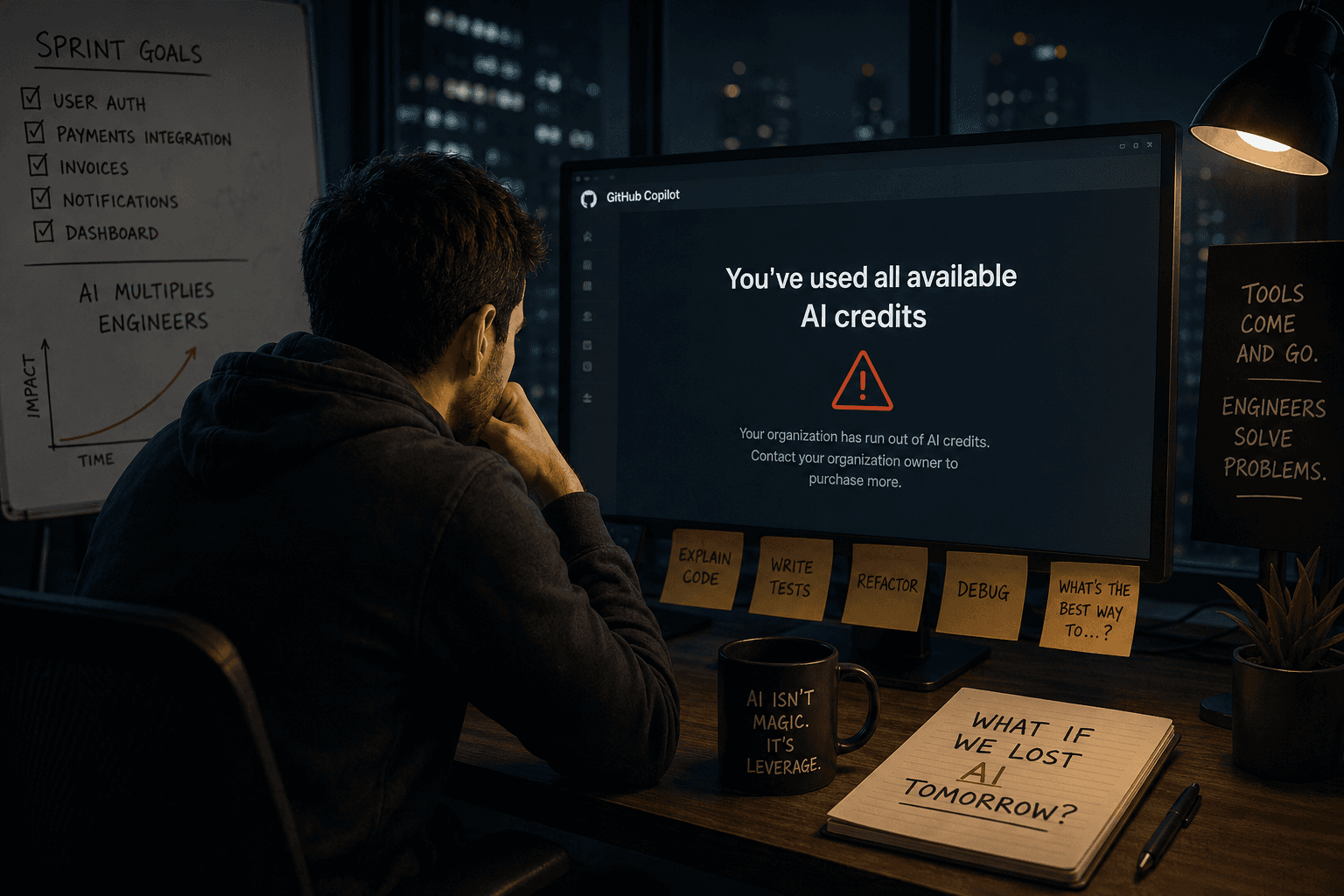
What would happen if your engineering team lost access to AI tomorrow?
No Copilot.
No Claude Code.
No Cursor.
No ChatGPT.
No code generation, code explanations, automated refactors, or AI-assisted debugging.
A year ago, most teams would have shrugged and continued working.
Today, I'm not so sure.
Recently, our team exhausted its GitHub Enterprise AI credits halfway through the month. Overnight, everyone lost access to GitHub Copilot.
The sprint didn't fail.
Nobody stopped shipping features.
But something changed immediately.
And that change forced me to think about a question I hadn't seriously considered before:
Have we already reached the point where AI is part of our engineering infrastructure?
⚡ The Day Everything Became Slightly Harder
The funny thing is that nothing dramatic happened.
No outages.
No incidents.
No missed deadlines.
Just friction.
Lots of friction.
Tasks that normally felt effortless suddenly required more concentration.
Reviewing pull requests took longer.
Understanding unfamiliar code required more reading.
Writing tests became more tedious.
Exploring different implementation approaches demanded more manual effort.
Individually, none of these delays were significant.
Collectively, they were impossible to ignore.
The entire team felt it.
The pace of work changed.
Not because engineers became less capable.
Because a layer of assistance had quietly disappeared.
🤖 We Didn't Replace Thinking. We Outsourced Friction.
One of the most common misconceptions about AI in software engineering is that it replaces engineering skills.
That wasn't our experience.
Nobody forgot how to design systems.
Nobody forgot how to debug.
Nobody forgot how to write code.
The difference was elsewhere.
AI had become responsible for removing hundreds of tiny interruptions throughout the day.
Consider how often modern engineers ask AI for help:
- 👉 Explaining unfamiliar code
- 👉 Generating test cases
- 👉 Refactoring repetitive logic
- 👉 Investigating error messages
- 👉 Summarizing pull requests
- 👉 Suggesting implementation approaches
- 👉 Understanding third-party libraries
None of these tasks are impossible.
Most aren't even difficult.
They're simply expensive.
Every one of them consumes attention.
And attention is one of the most limited resources in software engineering.
📉 The Productivity Metric Nobody Talks About
When people discuss AI productivity gains, the conversation usually revolves around speed.
How many tickets were completed?
How many pull requests were merged?
How many lines of code were generated?
I think those metrics miss the bigger picture.
The real impact is cognitive.
AI reduces context switching.
AI reduces research time.
AI reduces mental fatigue.
AI allows engineers to spend more energy solving actual problems rather than navigating information.
The biggest productivity gain from AI isn't writing code faster.
It's preserving mental bandwidth.
And once you experience that benefit consistently, losing it becomes noticeable very quickly.
⚠️ The Dependency Question
This is where things become interesting.
The moment our credits ran out, everyone noticed.
Not because we couldn't do our jobs.
Because we had become accustomed to a new way of working.
That's an important distinction.
Modern software engineers already depend on countless tools.
We depend on source control.
We depend on CI/CD pipelines.
We depend on cloud infrastructure.
We depend on package registries.
We depend on automated testing.
Nobody sees those dependencies as controversial anymore.
They're simply part of the environment.
The uncomfortable question is whether AI is rapidly joining that list.
If removing a tool impacts an entire team's velocity, focus, and workflow, can we still call it optional?
Or has it already become infrastructure?
🔄 This Feels Familiar
We've seen this pattern before.
Years ago, developers memorized documentation.
Then search engines became essential.
Later, Stack Overflow became essential.
Then cloud platforms became essential.
Each technological shift followed a similar path:
- It starts as a convenience.
- It becomes a competitive advantage.
- Eventually, it becomes an expectation.
AI seems to be moving through that exact same cycle.
Fast.
Very fast.
What feels optional today may feel indispensable a year from now.
💡 The Real Risk Isn't AI
Ironically, I don't think the biggest risk is becoming dependent on AI.
The bigger risk is forgetting the underlying skills.
There's a difference between using AI as leverage and using AI as a substitute for understanding.
The engineers who thrive in the coming years won't be those who can generate the most code.
They'll be the ones who can still evaluate, challenge, and improve what AI produces.
AI can accelerate execution.
It cannot replace judgment.
At least not today.
And judgment remains the most valuable skill in engineering.
🎯 Final Thoughts
Running out of GitHub Copilot credits didn't stop our team from delivering software.
But it exposed something important.
AI is no longer an experimental tool sitting on the edge of our workflow.
For many teams, it's already embedded in the way work gets done.
The discussion shouldn't be whether engineers are becoming obsolete.
That's the wrong debate.
The more interesting question is this:
If your team lost access to AI tomorrow, how much would your workflow change?
If the answer is "quite a lot," you're probably witnessing the next major shift in software engineering.
And chances are, it's already happening faster than you think.